Showing posts with label Biscotti. Show all posts

Wednesday, December 15, 2021

Pasticcini di mandorle


Let’s finish off 2021 on a sweet note. The recipe for these soft, chewy almond cookies comes from Rachel Roddy’s outstanding first cookbook, Five Quarters (2015). She also covered pasticcini di mandorle way back in 2010 on her food blog, Rachel Eats.


These pasticcini di mandorle contain only four ingredients: ground almonds, icing (aka powdered) sugar, lemon zest and egg. Roddy sampled the cookies while in Sicily, although versions exist across Italy. Carol Field’s The Italian Baker (1985, 2011) has a similar cookie recipe that hails from the Italian Alps. Bolle di neve (“Snowballs”) contain ground candied orange peel instead of lemon zest and egg whites in place of whole egg, but otherwise these Alpine and Sicilian cookies are kissing cousins. 


Here’s Roddy’s pasticcini di mandorle recipe, which makes 15 to 20 cookies.


350g ground almonds

200g icing sugar, plus extra for dusting

grated zest of 1 large unwaxed lemon

2 eggs, gently beaten with a fork


Preheat the oven to 180°C/160°C fan/gas mark 4 and line a baking tray with baking parchment. Mix the ground almonds, icing sugar and lemon zest in a large bowl. Add the beaten eggs and, using a fork or your fingers, bring the mixture together to form a soft, sticky dough.


Dust your hands with icing sugar and scoop out a walnut-sized lump of dough, then gently shape and roll it between your palms into a ball. Dust the ball with more icing sugar and put it on the baking tray. Continue until you have used up all the mixture. Make an indentation in the centre of each ball with your finger so that they cook evenly.


Bake for about 20 minutes, or until golden brown underneath and cracked, crisp and very pale gold on top. Transfer to a wire rack and allow to cool. They will keep in an airtight tin for up to a month.


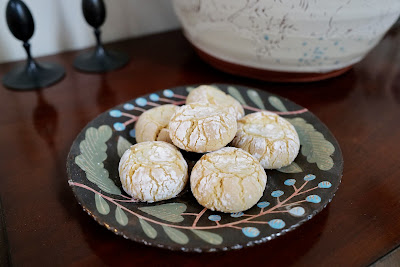
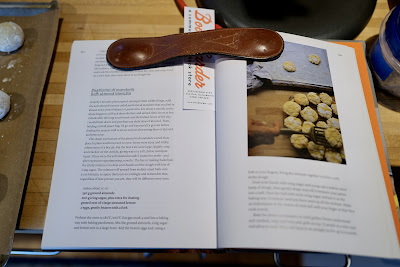
I converted 180°C/gas mark 4 to 350°F and baked without issue. Roddy writes that the “mixture will spread from walnut-sized balls into 5-cm biscuits, so space them out accordingly….” The photo of pasticcini di mandorle in Five Quarters definitely look flatter than my bake, but I sort of like the looks of the rounder version better. I used Bob’s Red Mill super-fine almond flour, so maybe that accounts for the difference. Or I didn’t shape gently enough? Or…who knows.


Make sure you follow the recipe and dust your hands with powdered sugar to roll the cookies. This dough is so incredibly sticky! But employing a little powdered sugar takes the fight right out of the dough.


Wishing everyone A Merry Christmas and A Happy New Year. Fingers crossed that 2022 turns out better than the last few years.

Friday, March 9, 2012

Quaresimali Toscani


After making fresh corzetti stampati (here) or tajarin (here) you will have leftover whites from 12 eggs. You can portion out the whites into small containers for future use. (Egg whites keep for a couple of days refrigerated in an airtight container or for a couple of weeks frozen.) An excellent way to use leftover whites: make biscotti. Although enjoyed year round, biscotti made with egg whites play a special role during this season of Lent when observants often shun rich ingredients such as butter and egg yolks.  Carol Field explores Italian feasts and festivals, including food-based Lenten traditions in her 1990 book entitled Celebrating Italy. In her chapter on Quaresima, or Lent, Field shares an excellent recipe for a chewy, chocolate biscotti made with egg whites called Quaresimali Toscani.

Field divides Celebrating Italy into four calendar-related parts: Abundance; Harvest; Darkness; and Rebirth. Each part features a range of Italian festivals that generally fall into four categories: (1) county festivals celebrating nature’s fecundity; (2) civic festivals; (3) religious festivals; and (4) political festivals. Field writes: “[a]ll have ritual foods that reflect agriculture and religion and consecrate the event.”

In Rebirth, Field writes about Italian Lenten traditions. She includes recipes for Croccante Quaresimale (Crunchy Hazelnut Cookies for Lent); Corolli (Anise-Scented Sweet Bread); Quaresimali Romani (Orange and Almond Biscotti); and Quaresimali Toscani (Orange-Flavored Chocolate Cookies for Lent).

If your goals are to use up leftover egg whites and observe Lent, look no further than Quaresimali Toscani. Perhaps these biscotti pass for Lenten fare because they contain virtually no fat (save for a very small amount in the cocoa). Even without fat, Quaresimali Toscani taste rich. Field writes that “[c]hildren in Florence look forward to these chewy chocolate cookies, which are shaped like alphabet letters during Lent.” Her recipe makes 21 to 24 alphabet cookies about 3 inches tall.
  • 2½ cups (250 grams) confectioners’ sugar
  • ¼ cup (30 grams) cocoa
  • 1½ cups (200 grams) unbleached all-purpose flour
  • Grated zest of 2 oranges
  • 2 teaspoons vanilla extract
  • 4 egg whites

Shift together the sugar, cocoa, and flour. Stir in the orange zest and vanilla. Add the egg whites, beating slowly, either by hand or at the lowest speed on the electric mixer, until the batter is thick and smooth.

Assembly. Butter and flour baking sheets or line them with parchment paper. Spoon the batter into pastry bags fitted with a ½-inch plain tip. Pipe out the batter in the shape of alphabet letters, about 1½ inches apart although they spread only very slightly.

Baking. Heat the oven to 300ºF. Bake the cookies until the tops have set and are slightly cracked but they still feel slightly soft, 10 to 12 minutes.


Easy to make (especially with a mixer), these biscotti straddle the line between cookie and candy. Imagine a delicious orange-flavored chocolate chew and you pretty much have Quaresimali Toscani. No wonder children look forward to them during Lent.

Friday, November 25, 2011

Crumiri


In a prior post I shared a recipe for Meini o Pani de Mei (here) from Carol Field’s The Italian Baker [1985]. Field writes that these cornmeal buns are a specialty of Italy’s Lombardy region. To celebrate the recent publication of a revised version of The Italian Baker, let’s explore another corn-based offering from Field’s excellent work: a delicious, buttery cornmeal biscotti from the Piedmont called Crumiri.

Field describes Crumiri as “delicate, crumbly horseshoe-shaped cookies”. The origin of Crumiri (sometimes called Crumiri di Casale or Krumiri ) dates back to the late 1800’s when a baker named Domenico Rossi invented the cookie after a night of social drinking in the town of Casale Monferrato in the Piedmont’s Alessandria province. What inspired Signore Rossi on that eventful evening in 1870? The cookie’s own name suggests inspiration came in the form of a then popular liqueur called Krumiro.

Crumiri generally come shaped as the horseshoe described by Field or as a gentle arc that purposely resembles the remarkable mustache of Vittorio Emanuele II. Cookie lore has it that in 1878 Rossi reshaped his Krumiri into a mustachioed form to recall the whiskers of the recently deceased king. Did this new shape do justice to the exemplar? You be the judge.


Being partial to butter and corn in almost any combination, I would like Crumiri even without its colorful history. I have a number of recipes for this biscotti; Field’s version tastes more refined than most with just the right amount of cornmeal. The recipe’s parenthetical comments belong to Field.

  • 1½ sticks plus 2 tablespoons (200 grams) unsalted butter, room temperature
  • ¾ cup (150 grams) sugar
  • 2 eggs, room temperature
  • 1¾ cups (240 grams) all-purpose flour
  • Pinch salt
  • 2/3 cup plus 1 tablespoon (120 grams) fine yellow cornmeal


Cream the butter and sugar in a mixer bowl until very light and fluffy. Add the eggs, one at a time, beating thoroughly after each addition. Shift the flour, salt and cornmeal together and sift again over the batter; mix well.

Shaping. You can shape these cookies either with a pastry bag or by hand (I think the latter is easier). If using a pastry bag, spoon the dough into the bag fitted with a 3/8-inch star-shaped tip (the traditional cookies are ribbed.) Pipe 4-inch-long logs, ½ inch thick, about 2 inches apart on buttered and floured or parchment-lined baking sheets. Or, roll pieces of the dough, each about the size of a walnut, into long thin logs of the same dimensions. Place 2 inches apart on the prepared baking sheets. Bend each piped or rolled log into a horseshoe.

Baking.  Heat the oven to 325º F. Bake until lightly golden, about 12 minutes. Cool on racks.

Field’s recipe makes two dozen cookies. I think the ridges distinguish these biscotti, so I use a pastry bag and star-shaped tip when making them. If you decide to pipe the dough, be sure to cream the butter, sugar and eggs thoroughly; otherwise the cookies will spread and flatten out during baking and you will lose the Crumiri’s traditional ridges. One approach: using a paddle attachment, cream the butter and sugar in a mixer set on medium-high speed for about 3 minutes.  After reducing the speed to low to add the eggs, increase the mixer’s speed to medium-high and cream for 8 minutes. Quickly mix in the dry ingredients and you are ready to bake.


Saturday, December 11, 2010

Cantucci di Pinoli e Rosmarino


This is the second post in a short series on cookies. We began with a recipe for Strassburgers from a Swedish cookbook entitled Sju Sorters Kakor. Next up is a recipe for Cantucci di Pinoli e Rosmarino from a new cookbook by Mona Talbott and Mirella Misenti entitled Biscotti: Recipes from the Kitchen of the American Academy in Rome: Rome Sustainable Food Project [2010].

The American Academy in Rome’s mission is to foster the pursuit of advanced research and independent study in the fine arts and humanities. Inspired by Alice Waters’s vision of making the Academy’s food reflect its high ideals of scholarship and art, the Academy launched its Roman Sustainable Food Program in 2007. In Biscotti’s Forward, Waters writes: “The recipes in this book are a perfect expression of the values of conviviality and purity embodied by the Rome Sustainable Food Project. Each of these cookies brings with it a taste of time and place—the ingredients are seasonal, organic and local—and no cookie is so big or so sweet that eating one will interrupt conversations at the end of a meal.”

Biscotti is not and makes no claim to be a collection of authentic Italian recipes. Rather, the cookbook features fifty cookies that are a part of the kitchen’s repertoire. Some of the cookies are Italian, for example Brutti Ma Buoni (or Ugly but Good). Other cookies are quintessentially American, such as Snickerdoodles. However, all of the cookies in Biscotti are Italian in spirit; like Roman cooking, they are direct and simple. Essential flavors of Italy—pine nuts and rosemary, cornmeal and almonds, pistachios and oranges—permeate the book’s collection.

If you pick up this book you will be struck by its handy size. Like Sju Sorters Kakor, it is half the size of a typical cookbook. I find these dimensions particularly useful and friendly. (A number of my British cookbooks are like-sized.) Biscotti can and should be compact as it presents a limited offering. I think its narrow focus is a virtue and not a fault. Biscotti is concise and easy to use.

I also like the size of the kitchen’s cookies. As Waters states, the biscotti presented are piccolini (i.e., small or tiny). They are just the right size to serve with coffee or tea, or as a dessert with a glass of wine.

Here is a recipe for a pine nut and rosemary cookie called Cantucci di Pinoli e Rosmarino. This unique and wonderful cookie is a variation of the classic, twice-baked Biscotti di Prato.
  • 110 g / ¾ cup pine nuts
  • 175 g / 1¼ cups all-purpose flour
  • 10 g / 2 tbsp fine cornmeal
  • 2 g / ½ tsp baking powder
  • 2 g / ½ tsp salt
  • 4 g / 2 tsp rosemary, minced
  • 60 g / ¼ cup + 1 tsp butter
  • 138 g / ½ cup + 3 tbsp granulated sugar
  • Grated zest of 1 lemon
  • 1 large egg
  • 10 ml / 2 tsp Marsala

1) Preheat the oven to 150°C / 300°F.

2) Spread the pine nuts evenly on a baking sheet and toast for 8 – 10 minutes or until golden.

3) Combine the flour, cornmeal, baking powder, salt and rosemary in a medium-size mixing bowl.

4) Cream the butter, sugar and lemon zest at high speed until light and fluffy. Add the egg and mix until well incorporated. Change to low speed and add the Marsala. Add the dry ingredients to the butter mixture in two parts and then gently fold in the pine nuts until evenly combined. Wrap the dough in plastic film and refrigerate for 15 minutes.

5) To bake, preheat or reset the oven to 180°C / 350°F.

6) Remove the dough from the refrigerator and divide it in two. On a floured surface form each portion into logs 2.5 cm/ 1 inch in diameter. Transfer the logs to a cookie sheet lined with parchment paper and bake for 20 minutes.

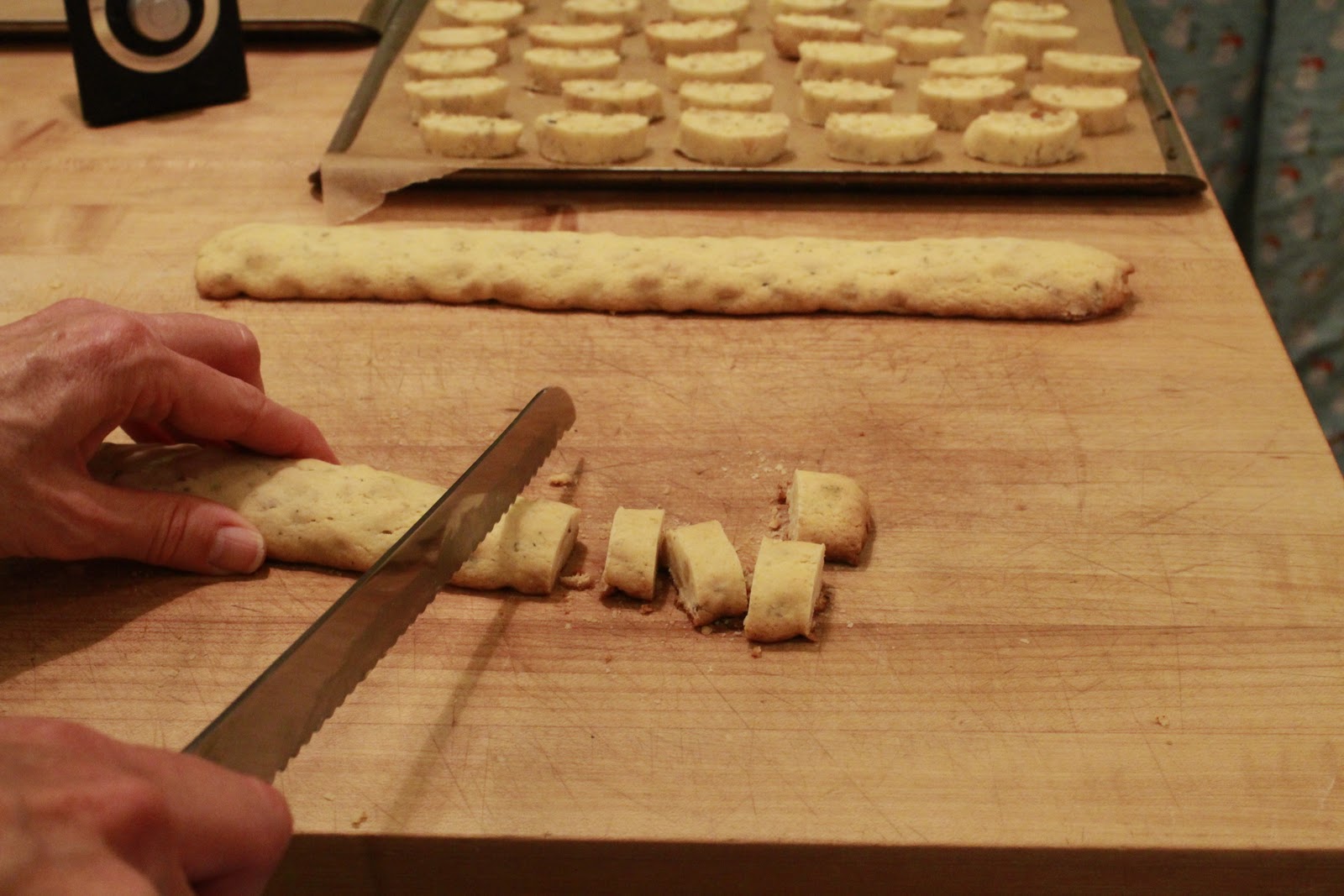
7) Once cool transfer the cookie logs to a cutting board and cut them into approximately 1-cm / ½-inch slices with a serrated knife. Lay the cookies flat on cookie sheets lined with parchment paper and bake for 6 – 8 minutes, until golden brown.

These cookies will keep well in a sealed container for up to 1 month. Yields 60 cookies.


I baked the cantucci using the metric measurements without incident. I also substituted white wine for the Marsala and the cookies tasted great.

Sunday, August 8, 2010

Meini o Pani de Mei


From Miss Fairfax we learn that “cake is rarely seen in the best houses nowadays.” But what about sweet corn cookies from Italy? Meini o Pani de Mei are always fashionable, especially with tea or after dinner served with coffee or a glass of white wine.

Italian cookies are remarkably diverse. Regional factors such as trade, prosperity, religious celebrations and geography influence the many variations. You find more butter-based cookies in the cooler, dairy-rich North and more olive oil- and ground nut-based cookies in the warmer South. Regions that grow corn, such as Emilia-Romagna and Lombardy, have traditional maize cookies. Sicily excels in almond production and almond paste cookies are found throughout the region. Piedmont’s hazelnut orchards beget hazelnut cookies.

The following recipe for Meini o Pani de Mei is from Carol Field’s The Italian Baker [1985]. Although classified by Field as bread, Meini are more cookie than bun, muffin or scone. They are traditionally enjoyed on 24 April “as a celebration of the liberation of [the Milanese] countryside from the assault of a ferocious highwayman and his brigands during the Middle Ages.” The Milanese also traditionally serve these cookies on All Souls’ Day to bring cheer on a day of remembrance. These are happy cookies.

  • 2 sticks plus 2 tablespoons (250 grams) unsalted butter, room temperature
  • 1¼ cups (250 grams) granulated sugar
  • 2 tablespoons plus 2 teaspoons honey
  • 1 egg
  • 1 egg yolk
  • ½ cup plus 2 teaspoons milk
  • 3¼ cups (450 grams) unbleached all-purpose flour
  • 1¾ cups plus 1 tablespoon plus 1 teaspoon (300 grams) fine yellow cornmeal
  • 3½ teaspoons baking powder
  •  2 drops almond oil or 1/8 teaspoon almond extract
  • About 1/3 cup (70 grams) granulated sugar
  • ½ cup (70 grams) confectioners’ sugar

By Mixer Only         Using the whisk if you have one, beat the butter, 1 cup plus 3 tablespoons sugar, and the honey for 1 to 2 minutes at low speed until combined. Increase the speed to medium-high and beat until light and fluffy. Add the egg, egg yolk, and 2 teaspoons milk and continue beating for 1 minute. Mix in the flour, cornmeal, and baking powder. Add ½ cup milk and the almond oil and mix at the lowest speed until blended. The dough should be stiff but not heavy. Knead briefly by hand or mixer, sprinkling with additional flour as needed, until buttery, soft, pliable, and slightly sticky.

Shaping         Line baking sheets with parchment paper or buttered brown paper. Cut the dough into 15 equal pieces (3 ounces or 90 grams each). Flour your hands and roll each piece into a ball. Flatten each ball into a ½-inch-thick patty, the size of a hamburger and the width of a woman’s hand. Place on the paper-lined baking sheets.

Glazing         Brush the tops with water and then sprinkle with granulated sugar, making sure a thin layer of sugar covers each bun. You can shake off the excess sugar by holding on to the paper and shaking the sugar up and over the edge of the pan. Place the confectioners’ sugar in a sifter or sieve and sift the sugar heavily over the buns so that they look as if they’re lost in a blizzard of sugar. The excess powdered sugar can stay on the paper because it will not caramelize.
Baking         Heat oven to 375ºF. Bake until the sugar on top has cracked into an irregular design, 15 to 20 minutes. Cool on racks. Makes 15 buns.


It is hard to imagine that a recipe containing the words patty, hamburger and woman’s hand can produce such excellent cookies.

Some thoughts and comments on this recipe: Field calls for 1¼ cups (250 grams) granulated sugar but only adds 1 cup plus 3 tablespoons when creaming the butter. The recipe does not account for the 1 tablespoon difference. I have baked different batches using each measurement and the cookies taste just fine either way. The 1¼ cups (250 grams) version is sweeter.

Over time I have moved from larger to smaller Meini. The recipe divides the dough into pieces weighing approximately 3 ounces or 90 grams. The accompanying photographs show pieces weighing approximately 2 ounces or 60 grams. This smaller size yields 24 cookies instead of 15. I like to serve the smaller cookies as a simple dessert. If you decide to bake smaller cookies, check them after baking for 15 minutes.