Showing posts with label Cookies. Show all posts

Wednesday, December 15, 2021

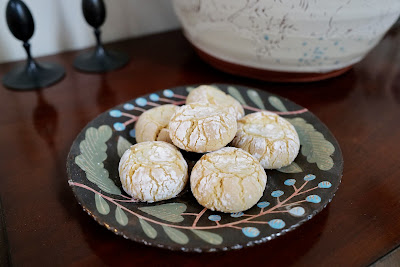
Pasticcini di mandorle


Let’s finish off 2021 on a sweet note. The recipe for these soft, chewy almond cookies comes from Rachel Roddy’s outstanding first cookbook, Five Quarters (2015). She also covered pasticcini di mandorle way back in 2010 on her food blog, Rachel Eats.


These pasticcini di mandorle contain only four ingredients: ground almonds, icing (aka powdered) sugar, lemon zest and egg. Roddy sampled the cookies while in Sicily, although versions exist across Italy. Carol Field’s The Italian Baker (1985, 2011) has a similar cookie recipe that hails from the Italian Alps. Bolle di neve (“Snowballs”) contain ground candied orange peel instead of lemon zest and egg whites in place of whole egg, but otherwise these Alpine and Sicilian cookies are kissing cousins. 


Here’s Roddy’s pasticcini di mandorle recipe, which makes 15 to 20 cookies.


350g ground almonds

200g icing sugar, plus extra for dusting

grated zest of 1 large unwaxed lemon

2 eggs, gently beaten with a fork


Preheat the oven to 180°C/160°C fan/gas mark 4 and line a baking tray with baking parchment. Mix the ground almonds, icing sugar and lemon zest in a large bowl. Add the beaten eggs and, using a fork or your fingers, bring the mixture together to form a soft, sticky dough.


Dust your hands with icing sugar and scoop out a walnut-sized lump of dough, then gently shape and roll it between your palms into a ball. Dust the ball with more icing sugar and put it on the baking tray. Continue until you have used up all the mixture. Make an indentation in the centre of each ball with your finger so that they cook evenly.


Bake for about 20 minutes, or until golden brown underneath and cracked, crisp and very pale gold on top. Transfer to a wire rack and allow to cool. They will keep in an airtight tin for up to a month.


I converted 180°C/gas mark 4 to 350°F and baked without issue. Roddy writes that the “mixture will spread from walnut-sized balls into 5-cm biscuits, so space them out accordingly….” The photo of pasticcini di mandorle in Five Quarters definitely look flatter than my bake, but I sort of like the looks of the rounder version better. I used Bob’s Red Mill super-fine almond flour, so maybe that accounts for the difference. Or I didn’t shape gently enough? Or…who knows.
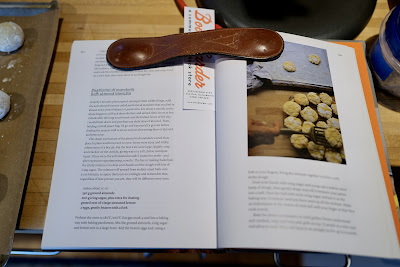


Make sure you follow the recipe and dust your hands with powdered sugar to roll the cookies. This dough is so incredibly sticky! But employing a little powdered sugar takes the fight right out of the dough.


Wishing everyone A Merry Christmas and A Happy New Year. Fingers crossed that 2022 turns out better than the last few years.

Saturday, April 10, 2021

Kokostoppar


In the weeks leading up to Easter, I baked a lot of different cakes and cookies. One simple cookie stood out. The recipe comes from Magnus Nilsson’s The Nordic Baking Book (2018). Nilsson calls the cookies Coconut Pyramids. In Danish, they go by the name kokostopper, and in Swedish, kokostoppar. If you like coconut macaroons, then you will love these buttery cookies. The recipe makes about 20 pyramids.


2 eggs

90g sugar

200g desiccated coconut

good pinch of salt

75g butter, melted and cooled to room temperature


“Preheat the oven to 175°C/345°F and line a baking sheet with baking (parchment) paper.


Put the eggs and sugar in a bowl and whisk until mixed. Add the desiccated coconut, salt and the butter and stir until fully combined. Let the batter sit for 20 minutes so that the coconut can absorb a bit of the moisture and swell, this makes shaping the pyramids considerably easier.


Spoon 20 piles of the mixture onto the prepared baking sheet and shape them into pyramid shapes using your hands or a spatula. Bake for 10-15 minutes. They should be golden on the edges of the pyramid but blonde on the flat sides. Coconut pyramids go dry if overcooked. Remove from the oven and leave them to cool.”


This might be one of the tastiest—and certainly the easiest—cookies I have ever made. When I first read the recipe, I wondered if shaping the pyramids might be tricky, but it’s not. I used my hands to form some of the pyramids and a spatula to make others. I think hands work best. In his introduction to the recipe, Nilsson writes that “[t]hese pastries don’t have to be shaped like pyramids, I just like them that way. It works just as well to simply spoon them out onto the paper in rough piles before cooking them.” I like the pyramids, too. The shape makes for a fun cookie.


What makes kokostoppar special is the rich butter and coconut flavor. Many of the coconut macaroon recipes that I have collected do not include butter and use only egg whites. I have eaten plenty of these versions and some are great. Personally, I like the option of making a rich coconut cookie. I also like that these kokostoppar aren’t too sweet. 


Wednesday, May 20, 2015

Hasselnötsflarn


In November of 2010 I shared a recipe for a comet-shaped butter cookie called a Straussburger (here). This recipe came from the 2008 English translation of the classic Swedish cookbook Sju Sorters Kakor or, in English, “Seven Kinds of Cake”. Swedes love the simple act of coming together during the day for coffee and conversation and a considerate host offers up at least seven kinds of cakes and cookies. Since 1945 home bakers have turned to Sju Sorters Kakor for recipes to help fill their cake and cookie trays. If this Swedish practice of slowing down and enjoying coffee and something to eat appeals to you, then I recommend Fika: The Art of the Swedish Coffee Break by Anna Brones and Johanna Kindvall. While Sju Sorters Kakor focuses on recipes, Fika explores the very Swedish act of taking a respite with coffee (or tea or some other beverage) and a snack.

Brones and Kindvall divide Fika into an introduction and five chapters: (1) a history of Swedish coffee; (2) modern-day fika; (3) the outdoor season; (4) celebrating more than the everyday; and (5) bread, sandwiches, and fika as a snack. So what exactly is a Swedish fika? Fika, which Swedes use as both a verb and a noun, essentially means “to drink coffee”. But as parsed by Brones and Kindvall, fika means more than just taking a break with a drink and snack. Fika changes depending upon its context. It might be a simple cup of tea and biscuit on a trip, a celebratory treat, or an opportunity to catch up with a friend.

Each of Fika’s chapters contains between 8 to 10 uniquely Swedish recipes to make and then enjoy whilst you fikastund (the moment you have fika). The majority of the book’s recipes lean toward baked goods, mostly sweet but some savory. Boy, do these treats sound appealing! Brones and Kindvall include recipes for kladdkaka, a flour-less sticky chocolate cake; kinuskikaka, a sweet caramel cake that originated in Finland; and semlor, Swedish cream buns most often associated with pre-Lenten Fettisdagen (Fat Tuesday) celebration.  Fika also contains recipes for jams and even beverages, such as rabarbersaft (rhubarb cordial), flädersaft (elderflower cordial) and glögg (Swedish mulled wine).

With so many tempting options, I had a hard time deciding what to bake first! I went with the hasselnötsflarn (hazelnut crisps) because they look dead simple to make and because, well…I’m a sucker for small, crisp cookies. The key to the recipe lies in making sure the baked crisp is golden brown—the authors’ say “dark golden brown”—around the edges. I didn’t push my first batch quite this far and the cookies, although sweet and delicious, weren’t quite crisp enough. The second batch turned out fine. The recipe makes about 30 cookies.

¼ cup (2 ounces, 57 grams) unsalted butter

¾ cup (3.75 ounces, 106 grams) raw hazelnuts

1 egg

½ cup (3.5 ounces, 99 grams) natural cane sugar

½ teaspoon pure vanilla extract

Preheat the oven to 350°F (175°C). Line a baking sheet with a silicone baking mat or parchment paper.
In a saucepan, melt the butter. Remove from the heat and set aside.
In a food processor, grind the hazelnuts until almost finely ground.
In a bowl, whisk the egg until frothy, then stir in the sugar and vanilla. Pour in the slightly cooled butter and mix together until well blended. Add the hazelnuts and stir until an even batter forms.
Spoon the batter by 1-teaspoon drops onto the baking sheet, leaving 2-inches (5 centimeters) between each cookie. If you make then slightly larger, just be sure to flatten them with your fingertips so that they bake to an even crisp.
Bake for 8 to 10 minutes, until dark golden brown around the edges. Remove from the oven and let cool on the baking sheet until they are hard, them carefully transfer them to the counter.
When fully cooled, store in an airtight container to keep the cookies crisp.
Some notes and thoughts. I followed the weights given and everything when smoothly. (You have to love a cookbook recipe that calls for 99 grams of sugar—not 100 grams, not 98 grams, but 99 grams of sugar.) I skinned the hazelnuts (just because) and added just a bit of sugar before pulsing the nuts in a food processor (to avoid making a nut butter). All told, hasselnötsflarn are very easy to make from Fika’s clear recipe.
Fika, published by Ten Speed Press, is a neat little book done extremely well. I particularly like Johanna Kindvall’s lovely illustrations and kudos to Betsy Stromberg for her handsome book design. I look forward to pulling Fika off the shelf whenever I have a fikasugen (fika craving).


Sunday, July 21, 2013

Arnold Circus Biscuits


At year-end, I compile a list of my favorite cookbooks of the year. (Quick aside: 2013 looks to be an outstanding year for cookbooks. Stay tuned!) In 2012, Margot Henderson’s You’re All Invited topped my best-of list, hands down. Henderson filled her cookbook with recipes from her catering business, Arnold & Henderson; and from her London restaurant, Rochelle Canteen. These recipes—whether fancy(ish) or simple—feel honest: straightforward food to enjoy during any celebration, whether a Christmas Dinner or New Year Party or even a quiet Date Night at home. Although published in Britain, the recipes in You’re All Invited should pose no real problem for American households. It’s a wonderful and gracious cookbook and I highly recommend it.

Being a dessert and tea-loving lot, my family particularly likes the Pudding and Cakes section of You’re All Invited. In it Henderson shares a recipe for Arnold Circus Biscuits, a version of a cookie called an Anzac biscuit in her native New Zealand. Anzac stands for Australian and New Zealand Army Corp and the original rolled oat cookie recipe dates back to World War I. The wartime biscuit needed to survive long, slow journeys without spoiling, thus it contained neither eggs nor butter. Instead, the biscuit relied on ingredients not apt to spoil (in this case, oats, flour, coconut and sugar). Modern versions of the recipe still omit eggs, but many, including Henderson’s recipe, now contain butter.  Why does Henderson call her version Arnold Circus Biscuits? Perhaps because she located her catering business and restaurant in an old Victorian school—its old bike shed, to be specific—in East London’s Arnold Circus. So I think of the biscuit as her house cookie. Henderson’s recipe makes about 36 biscuits.

100g porridge oats
75g desiccated coconut
100g plain flour
100g caster sugar
50g demerara sugar
100g butter
50g golden syrup
1 teaspoon bicarbonate of soda
Preheat the oven to 180ºC/fan 160º/350ºF/gas 4, and line 2 baking trays with baking paper.
Put the oats, coconut, flour and both sugars into a large bowl and mix to combine.
Put the butter into a pan and add the golden syrup. Heat slowly and stir with a wooden spoon until the butter and syrup have melted together. Put the bicarbonate of soda into a cup, add 2 tablespoons of boiling water and mix to dissolve. Pour the mixture into the pan. Stir with a wooden spoon, then tip into the dry ingredients and mix to a crumbly paste.
Take teaspoonfuls of the mixture and roll them into balls. Place them on the cold baking trays, leaving a space of at least 3cm between them because they will spread as they cook. Bake for about 12 minutes, until they have spread out nicely and are a dark golden colour.
Cool on a rack, then store in an airtight tin.

Notes
For those of you that don’t speak British, some clarification might be in order. Porridge oats are rolled oats. Desiccated coconut means flaked or shredded coconut. Plain flour, as opposed to strong (high-protein) flour and soft (pastry) flour, is all-purpose flour. Caster sugar means super-fine sugar. Golden syrup, practically synonymous in England for Lyle’s Golden Syrup, is cane sugar syrup. Bicarbonate of soda translates to baking soda. Three centimeters equals just over an inch. And, of course, colour means color.


Although these cookies boast a long shelf-life, I can tell you that they don’t hang around too terribly long in my household: we can put away a batch in a couple of days. They are perfect with tea or as dessert (or even for elevenses…just ask my dear wife).

Tuesday, June 5, 2012

Arnhemse Meisjes


Let’s celebrate two years of A Serious Bunburyist with a biscuit. Last year I featured a recipe for Cream of Celery Soup (here) from Simon Hopkinson’s Second Helpings of Roast Chicken [2001]. Hopkinson’s book contains an eclectic collection of recipes that he amassed over the years. One of these recipes is for Arnhem Biscuits or Arnhemse Meisjes from Roald Dahl’s Memories with Food at Gipsy House [1991] (republished in 1996 and 2012 as the Roald Dahl’s Cookbook). Hopkinson describes Arnhemse Meisjes as “quite wonderful”. Dahl waxed slightly more lyrical about the Dutch cookies: “They were simply marvelous. I cannot quite tell you why, but everything about them, the crispness, the flavour, the way they melted away down your throat made it so you couldn’t stop eating them.”

Are Arnhemse Meisjes the best biscuits in the world? Dahl thought so. Coming from the author that penned some of the most glorious and tantalizing descriptions of food in all of children’s literature, this is high praise indeed. How did the recipe fall into Dahl’s hands? He writes that after tasting the biscuit at a book signing in the Dutch city of Arnhem, he requested and received the recipe from Albert Hagdorn, the baker that developed the cookie. Happily, Dahl decided to include Arnhemse Meisjes in his cookbook. The recipe makes about 35-40 biscuits. The asides are Dahl’s.
  • 190 gr plain flour
  • 100 gr milk
  • 4 drops lemon juice (more later if necessary)
  • 5 gr fresh yeast
  • 105 gr unsalted butter (divided equally into 5 pieces of 21 gr each)
  • a pinch of salt, only if using unsalted butter
  • rock sugar is used instead of a floured surface (I used sugar cubes that I lightly crush with a rolling pin)

1. Mix together the flour, milk, lemon juice and yeast, adding a pinch of salt if necessary.

2. With an electric beater on high speed, beat 1 piece of butter into the mixture for about 2 minutes. Continue in the same way for the remaining butter pieces.

3. Wrap the dough in cling film and refrigerate overnight so that it is easier to handle.

4. Preheat the oven to 275°F / 140°C / Gas Mark 1 and line your baking sheet with non-stick baking paper.

5. Dredge your rolling surface with the crushed sugar cubes (rock sugar), then roll out the dough over the sugar, sprinkling it with some more crushed sugar and continue to roll until very thin.

6. With a biscuit cutter, cut out the dough. (Ovals are the traditional shape.)

7. Place the biscuits on the lined baking sheets and sprinkle with more crushed sugar.

8. Bake for 30-45 minutes or until crisp and lightly golden.


Some notes and thoughts.  A standing mixer equipped with a paddle takes the work out of making this dough, which resembles a smooth taffy.  Rolling this dough isn’t too tricky if you work quickly. I aim for a finished thickness of about 1/8 of an inch. This produces an extremely crisp yet flakey cookie.

And while we are on the subject of crispness, Hopkinson provides a helpful bit of advice: “I noticed that when the biscuits had turned ‘slightly golden’ they were not exactly ‘crisp’. But then this is the case with all biscuits: they do not fully crisp up until left to cool. I only point this out so that you do not feel tempted to cook further (to a darker colour, which ruins them) just so that they turn crisp while still in the oven.”

Roald Dahl and Simon Hopkinson have authored similar yet remarkably individualist cookbooks. Their books present a diverse collection of favorite and meaningful recipes inspired by each author’s palate and memories. As I look back on the recipes featured during this site’s short two year run, it seems to me that A Serious Bunburyist—more by happenstance than design—isn’t too far off the Dahl and Hopkinson model: a varied and idiosyncratic selection of recipes that that hold a strong personal allure. So until my dear, invalid friend Bunbury explodes, more of the same to come.