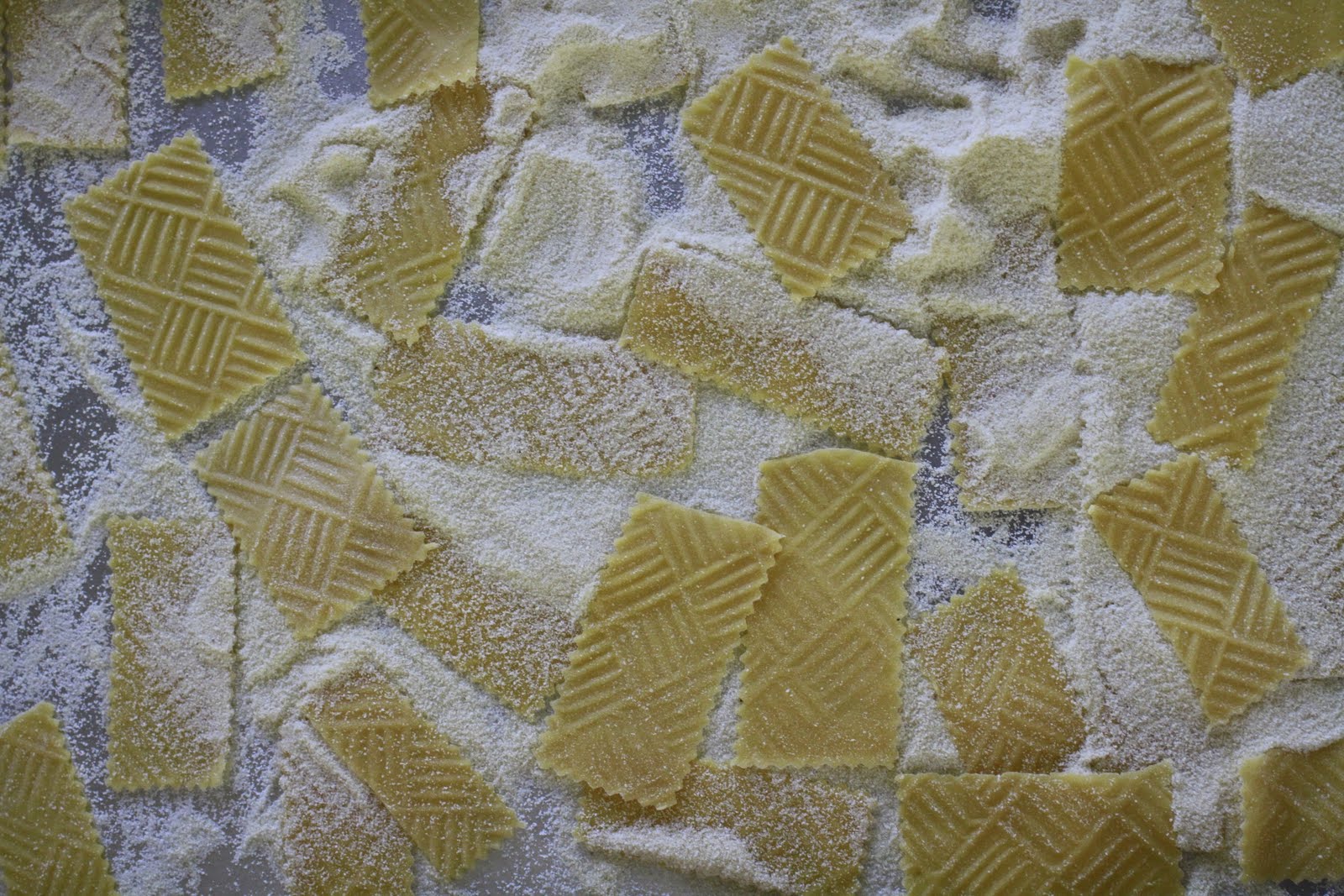
Last year I shared a
recipe for stracenate, a flat,
rectangular-shaped pasta from Southern Italy.
Stracenate has a unique
decorative pattern created by pressing pieces of pasta onto a carved wooden
board called a cavarola. Let’s now
move up the Italian Peninsula to explore a similarly distinctive regional pasta
most closely associated with Liguria. Corzetti
stampati’s large, coin-like shape is made by first cutting a circle out of
a sheet of pasta and then embossing the disc with an ingenious wooden tool aptly
called a corzetti stamp.

Research suggests fingers
rather than wooden stamps indented the earliest version of corzetti, which dates back to the thirteenth century. A
similar finger-pressed (and a factory-made) shape survives to this day and still goes by the name corzetti without the stampati qualifier; it resembles, to my
eye, a stylized figure 8.

By the Italian Renaissance, court pasta makers used carved wooden stamps to create corzetti stampati. Oretta Zanini De Vita writes in her Encyclopedia of Pasta [2009] that in addition to heraldry, early corzetti stamps “bore a little stylized cross…other molds were incised with geometric and vegetal motifs, or with references to the celebration for which they were made.”

By the Italian Renaissance, court pasta makers used carved wooden stamps to create corzetti stampati. Oretta Zanini De Vita writes in her Encyclopedia of Pasta [2009] that in addition to heraldry, early corzetti stamps “bore a little stylized cross…other molds were incised with geometric and vegetal motifs, or with references to the celebration for which they were made.”

Today corzetti stampati appears to be enjoying a modest renaissance.
Until recently recipes to make fresh corzetti
stampati were few and far between. Why the increase in popularity? The Internet
deserves some credit. Ten or more years ago locating a corzetti stamp in the United States was about as easy as finding a cavarola (i.e., it wasn’t). Now a Google
search turns up a handful of websites that sell corzetti stamps. Some of the most handsome stamps currently available come from Pietro Picetti (here), whose workshop is located in La Spezia, Liguria.

The dough recipes I’ve collected over the years to make fresh corzetti stampati range from using a single egg to incorporating a lot of egg yolks. Which version you choose is a matter of taste and preference. The following recipe, which serves 4, is more rich than lean.
- 220 grams Giusto’s Organic Baker’s Choice Unbleached Flour
- 12 egg yolks from large eggs
Follow the instructions
from my pappardelle post (here) with
the following differences: use egg yolks in place of whole eggs and knead the
dough for at least 20 to 30 minutes, dusting with flour as necessary. When rolling
the pasta aim for a finished sheet that is approximately 2mm thick.
Lightly flour both sides
of your finshed pasta sheet. Using the concave portion of the corzetti stamp’s base, cut out discs
from the pasta sheet. Flour the corzetti stamp’s
flat, carved surfaces. Place a pasta disc between these two surfaces and firmly
press the handle and base together to coin the disc. Repeat with remaining
discs.
Place the newly minted corzetti
stampati on a baking sheet coated with course semolina flour. Allow the
pasta to rest for approximately 1 hour before cooking. This brief drying period
helps the pasta to retain its decorative pattern when cooked. Boil in salted
water (approximating the taste of seawater) until the corzetti stampati are done; cooking time will vary based upon the
pasta’s thickness and dryness.


To accentuate its Ligurian lineage, consider serving corzetti stampati with a basil pesto
(adding green beans to the dish if you like). If you want to try another
classic combination, finish the cooked coins in a butter sauce containing fresh
marjoram, pine nuts and Parmigiano-Reggiano.